


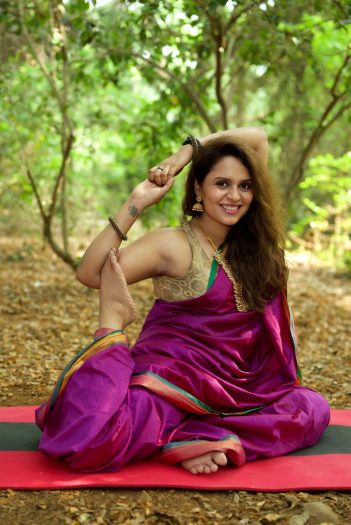
By Prerna Sinha, maaofallblogs
There’s something quietly powerful about blending tradition with movement—and practicing yoga in a saree does exactly that. Often seen as restrictive, the saree can, in fact, become a graceful companion to gentle stretches and mindful breathing when approached with the right asanas. For beginners, this practice is less about perfection and more about reconnecting with your body in a way that feels rooted, comfortable, and culturally expressive.


In 2019, Nisha Millet — India’s most decorated swimmer and an Olympian — posted photographs of herself swimming laps in a saree. I, of course, did not invent the idea of a woman performing at the highest level in a saree. I am proud to bring back attention to this garment as a functional one when I perform yoga and fitness challenges in a saree.
How did I start Saree Yoga?

I didn’t plan on doing yoga in a saree. Women would send me messages saying that they love the sarees I wear, but they found wearing one cumbersome and tough. Having grown through this cycle myself, I wanted to break the stigma around the saree.
As a yoga teacher, yoga has always been a part of my life, and I used to do Monday Fitness Challenges on my Instagram page for years. I just started doing those challenges in a saree, and pleasantly, it was appreciated by many women and men across.
Saree yoga is for those women. It is a way back in, not only tradition for tradition’s sake.
If this has made you want to try it, here is where to begin.
Asanas That You Can Practice In A Saree

Tadasana — Stand with feet hip-width apart, weight evenly distributed. Hold for 8 breaths.
Vrikshasana — Tree Pose. The fabric creates subtle instability around the standing leg, which means the core and the hip stabilisers must work harder to maintain balance. Place the sole of one foot on the inner thigh or calf, never the knee. Arms can come to prayer at the chest or extend overhead. Hold for 6 breaths on each side.
Virabhadrasana I — Warrior I: Step the right foot forward into a deep lunge. The fabric between the knees will create resistance as you widen your stance. Do not fight it. Take a slightly narrower stance and focus the energy upward — arms reaching overhead, chest open, breath full. The narrower base actually deepens the core engagement. Hold for 6 breaths on each side.
Virabhadrasana II — Warrior II: Arms extend wide — right arm forward, left arm back. The front knee is bent. The gaze is over the front fingertips. Hold for 8 breaths on each side.
Utkatasana — Chair Pose Chair pose in a saree is genuinely challenging and genuinely transformative. As you sit back into the pose, the pleats of the saree will gather at the front of the knees. Let them. The weight of the fabric pulls slightly downward as the thighs burn upward — creating a beautiful opposition of forces. Arms reach forward or overhead. Hold for 6 breaths. Repeat 3 times.
Parivrtta Utkatasana — Twisted Chair From Chair Pose, bring palms to prayer at the chest. Exhale and twist the right elbow to the outside of the left knee. The fabric around the hip and waist gently limits the rotation, which means the thoracic spine must do more of the work. Hold, breathe into the twist, then repeat on the other side. Hold for 5 breaths on each side.
Trikonasana — Triangle Pose: Open the feet wide — about three to four feet apart. Right toes turn out, left toes slightly in. Extend the right arm down toward the shin or the floor, left arm reaching straight up toward the ceiling. Hold for 6 breaths on each side.
Natarajasana — Dancer’s Pose. Standing on the left leg, bend the right knee and reach back to hold the right ankle or foot. Hold for 5 breaths on each side.
Bhujangasana — Cobra Pose. Come to the floor. Lie face down. Place palms under the shoulders and on the inhale, press the chest forward and up. Focus entirely on the opening of the chest and the lengthening of the spine. Hold for 5 breaths. Repeat twice.
Supta Baddha Konasana — Reclined Butterfly: Lie on your back. Bring the soles of the feet together and allow the knees to fall wide. Arms rest at the sides, palms facing up. This is the restorative pose. Stay for 2 minutes.

Things to take care of;
1. The pallu escapes mid-pose – It can land on your face, and you can lose balance. Do remember to pin the pallu at the shoulder AND tuck the end into the back of the petticoat.
2. The blouse arm restriction – you realize this when you raise your arms overhead, and the blouse feels tight or starts tearing. Always do a full arm-raise test before any session. Use a sports bra or crop top for active practice. My go-to during fitness challenges.


3. The unexpected colour reveals – You chose the saree carefully, but not the cycling shorts underneath. Mid-pose, the drape shifts. Always check your underlayer against the saree in natural light before filming. Neutral blacks are the safest foundation.
4. Imagine you are attempting a wide-legged stance, but the saree is pulling at the knees. For wide-stance poses, adjust the lower drape before entering. Give the fabric permission to move by creating slack first.
5. Petticoat string goes rogue. Tied perfectly at home. Somehow, between the car and the mat, it has loosened to a dangerous degree. You discover this during a forward fold. Time stops. Survival tip: Always do a test fold before recording. Tie at the natural waist — not the hips. Always carry a spare safety pin.
6. Silk saree and yoga challenge – The silk looks stunning, but while doing Bakasana, the legs can slip. Use silks for floor asanas, but for active sequences, use cotton, linen, or georgette.
7. The petticoat quietly migrates upward – Tie at the natural waist, not the hips — and be tied firmly but not tightly. I usually use cycling shorts under my sarees while doing these challenges, but have done a few with the petticoat as well; the gathering of the fabric is more in such a case. But for the Nauvari saree, you can just wear tights or cycling shorts.

8. During poses like Vrikshasana, the fabric can wrap around the standing ankle. For single-leg balance, ensure no loose fabric near the ankles. Nauvari saree is ideal here — legs already free.
9. The pleat opening- The most common thing to happen while doing a challenge. What can you do? Stitch or pin the pleats before starting, or use stitched sarees.
10. Your drape is your foundation. Spend time understanding your drape style before you begin the physical practice. A Nivi and Maharashtrian drape allows different movement than a Coorgi or a Gujarati drape. I switch between pre-stitched nauvari sarees and tying myself one before a challenge. For some asanas Nivi drape may not be suitable, like splits.
It might sound complicated, but over time with practice, you will be able to work with it. As a Saree yoga practitioner, I feel that my practice has improved significantly after Saree sessions, because the fabric trains mindful, intentional movement.